


TL;DR
Overview - Designed a global clienteling app for Pernod Ricard prestige business
As one of two product designers on a one-month validation sprint for a Hong Kong leading F&B supplier's new wholesale ordering platform. We tested it in person with real Hong Kong store owners before the wider launch.
The platform just finished the revamp to enable store owners to place orders by themselves without going through the sales team. The real risk was whether a store owner placing their first order alone would get stuck and fall back to sales anyway. Over a month of 2–3 moderated sessions a day, testing gave a split answer:
Store owners had the confidence (4.4/5) placing orders on their own.
100% first-order task success, yet the speed was 38.4% slower, because every user expected to choose delivery location and date first.
My main job scope covered interface iteration. With the research finding, I reordered the flow around delivery and delivered two main enhancements: Suggested Items from order history, and in-app onboarding. The testing itself de-risked the launch.
ROLE
Product Designer (owned UI iteraction) & User Researcher (co-lead testing sessions)
TIMELINE
Jul 2022 - Aug 2022
STAKEHOLDERS
Context
Sales team was occupied because of store owners' order requests and accounting tasks
Store owners order ingredients such as bread on a regular cadence, but the old platform had small UI and confusing display. It made store owners kept asking sales team to place orders. And the old platform wasn't integrated with ERP system and warehouse management. With the increased workload, sales team wasn't able to do prospecting or proper account management with existing customers.

Problem
Four months of build were done by the team, yet no real store owner had used the platform before the release
The urgent need was to validate the new version of platform with power users, which was the reason why I joined the team.

The real risk was the first order: a store owner who got stuck alone would call sales, and the platform would add workload instead of removing it.
Research objective
Prove store owners could order on their own, and fix what stopped them
The research had to produce two things:
Evidence: can a store owner place an order confidently without the sales team?
A refined interface: anything we should adjust to facilitate order placement?
Research Approach
In-person moderated sessions with real store owners overturned the flow's order: every user expected to pick delivery first
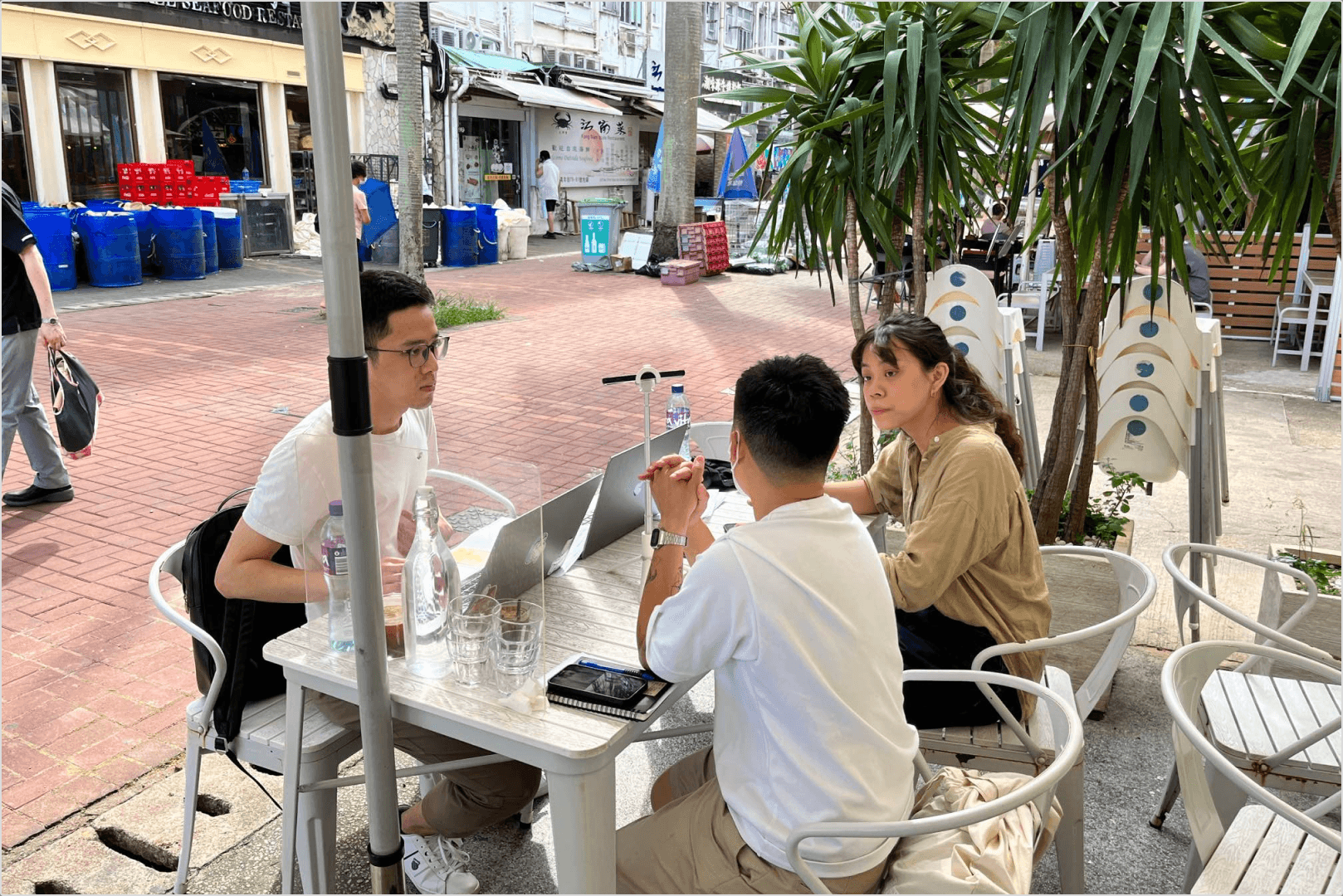
2–3 moderated usability sessions a day, in person with real Hong Kong store owners. In total we interviewed 9 store owners and staff who were in charge of placing wholesale orders. Another product designer and I alternated moderating and note-taking.
Store owners were asked to perform pre-defined tasks on the latest version of wholesale ordering web app.

Synthesis was run in Dovetail to ensure both product designers could synthesise the raw data with shared tags and themes, generating fact-based insights. We used this deliberately to keep the team's confirmation bias out of the conclusions.
Through the research, we identified:
✅ Users showed 4.4/5 confidence level of placing an order without sales team’s support.
⚠️ 100% task successful rate for placing the first order while 31% time decreased when placing returning orders.
⚠️ 38.4% time increased for first-time ordering due to the the expectation mismatch.
⚠️ The concept of "Order by box", "delivery location", and "Cut off time" were not clear to store owners.
Solutions
The biggest change was allowing users to re-order from the quick order page
Solution 1: Enable returning users to place new orders within the same page
During the research, we found the mismatch with store owners' mental model. They didn't expect to re-order through order history page. Thinking about anything related to ordering, they always go to "Quick Order" page.
Before


After
I changed re-order starting point from "Order History" to a new "Quick Order" page with below changes:
Make selecting delivery location and date the first CTA as some users mentioned “If I don’t choose the delivery date first, I would forget it.”
Display “Suggested Items” section and “Quick Add” to ensure ordering process can be done within the same screen
This aligned with users’ mental model while lowering their cognitive load. And they don't have to “Re-order” on Order History page or add items through product catalogue.
Solution 2: Display "Suggested Items" based on recent order history
During the research, store owners to see items that they order frequently while ordering instead of adding items from product catalogue.

I incorporated three most frequently ordered items as “Suggested Items” with the flexibility to see more based on recent order history. This was to match users’ need of finding relevant items quicker with flexibility to adjust quantity on the same page.
Solution 3: Implement in-app onboarding to increase users’ confidence and reduce errors
Previously, sales team answered lots of questions about "Order by box" and delivery location change for multi-store clients.
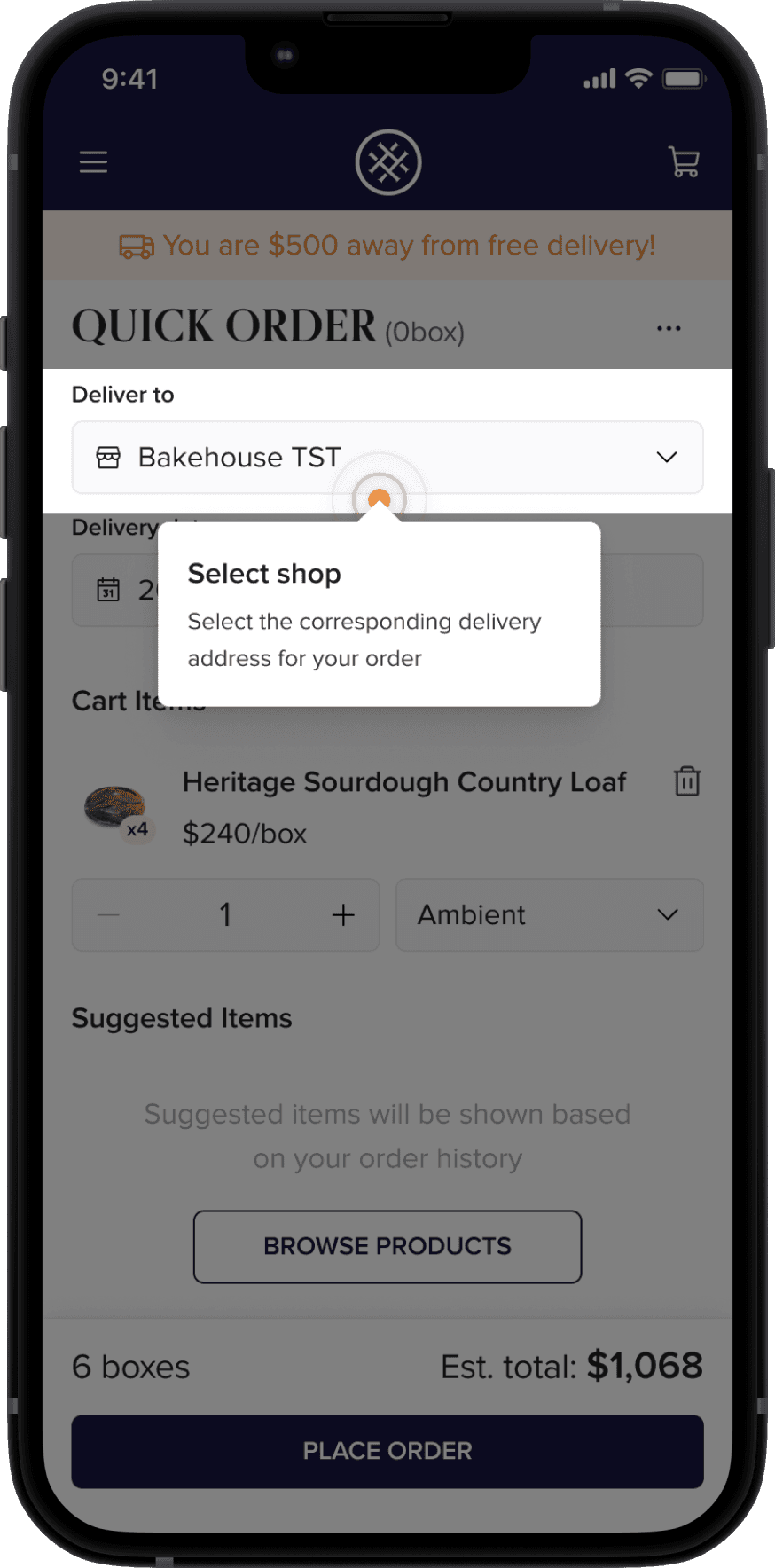
"Store selection"
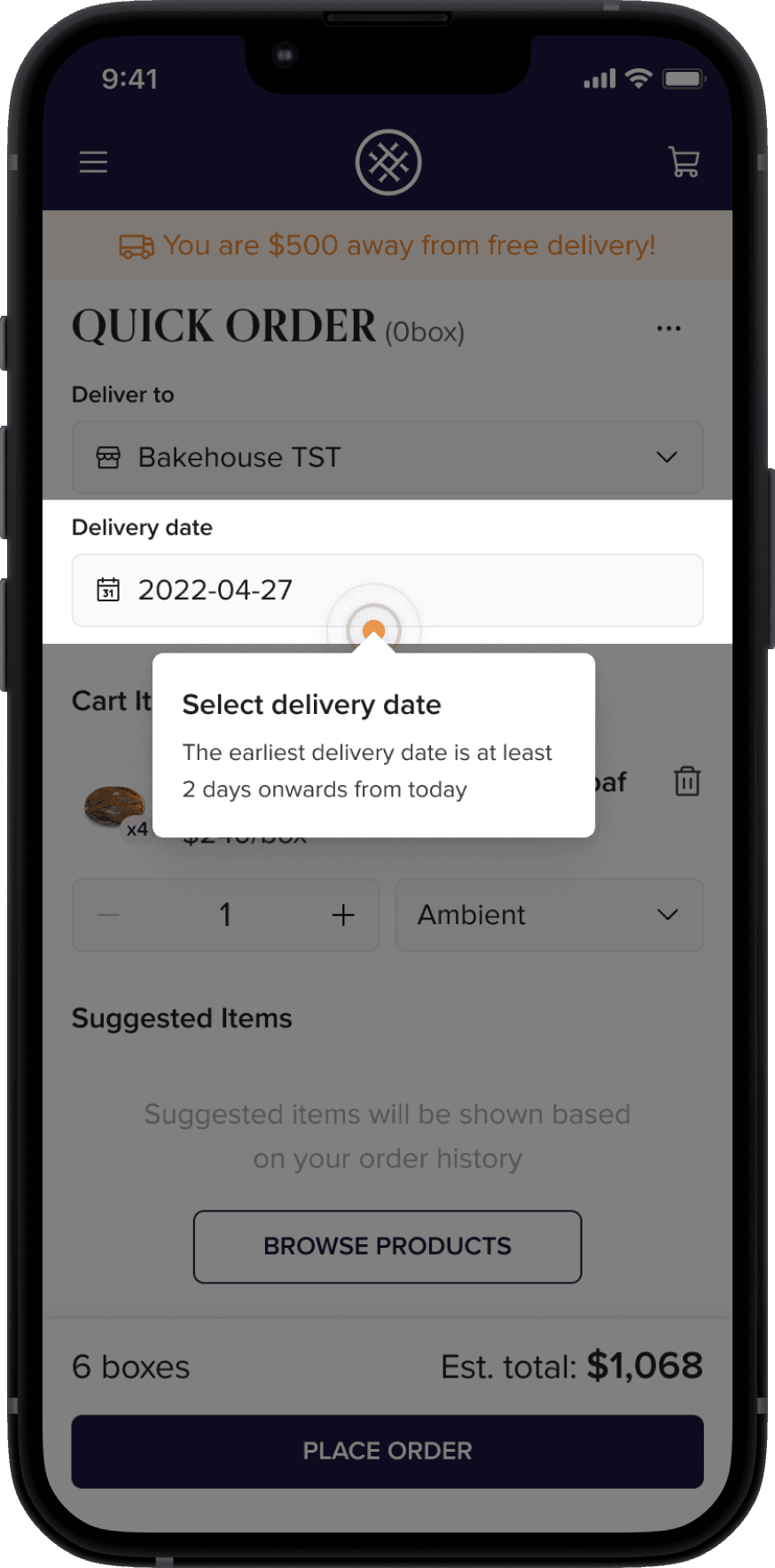
"Delivery date"
To reduce the error rate of selecting wrong store for delivery, we added tooltip when users open the "Quick Order" page to ensure they confirm the store as the first step, which also aligned with thier mental mode.
“How do I know when I can expect to receive the order?” was also one of questions store owners asked the most. That's why the onboarding specifically explain the cut-off time and the earliest delivery date.
"Order by Box"

Instead of hearing "Why I select one item but it becomes six in the end?”, with the tooltip reminder during onboarding, we wanted to educate users the difference between normal ordering and "Order by box".
IMPACT
Mitigated risks of store owners not using the new web app and ensured the smooth launch
Through the research, we confirmed the new web app could enable store owners placing orders on their own, which could free up sales team's time for other tasks.
With the adjustment of changing the sequence of delivery location and delivery date fields, the ordering flow aligned with store owners' mental model. Along with enhancements on onboarding flow, the new web app was smoothly launched.

To summarise, the impact of my project engagement contained:
For users: they were able to complete orders with the easy-to-use and efficient ordering process.
For Bread Elements: increased efficiency of order handling and reduced sales team's workload on addressing enquiries, which indirectly brought more potential business values to the company.
4.4/5
confidence placing orders without sales team support
100%
First-order task success during testing despite the slow speed