

TL;DR
I was the sole product designer on a clienteling app for the Private Client Managers (PCMs) of a global prestige-spirits business: the relationship managers for high-net-worth clients.
PCMs were losing an hour a day to client data, and nothing obliged them to give up their spreadsheets. So I made client data decision-ready, built around the three questions a PCM asks every day. 76% of end-users now use the app monthly, across 12 markets.
Context
Client knowledge is the raw material of a PCM's job: every clienteling action depends on it.
Client knowledge is the foundation of a PCM's sales process. It's what lets them act on the moments that matter (recruiting prospects, converting clients and upselling) with the right context.
Every clienteling action depends on client knowledgeProblem
PCMs lost an hour a day to scattered client data, and the business had no CRM strategy.
In 7 interviews with champion PCMs, 5 were unhappy with their tools because data was hard to enter and extract. They spent around an hour every day finding and recording client information. The root causes:
- User side: data wasn't accessible in the field, so PCMs prepared heavily before every meeting, and client information stayed scattered across WhatsApp, Excel and memory.
- Business side: there was no overall CRM strategy, and client knowledge left with every PCM who left the company.
Interviews with champion PCMs: client data lived in spreadsheets, chats and memory
The interviews surfaced the key pain points:
- Scattered client data was hard to extract.
- Connecting order data with client data to see purchase behaviour took time.
- PCMs interacted with clients based on their own memory and instinct.
Risk
The real risk was whether a PCM would ever abandon Excel.
My hypothesis: if the app makes client data decision-ready alongside order data, PCMs will not only adopt it over Excel but keep enriching it.
Product objective
Decision-ready data in one place, built around the three questions a PCM asks every day.
A PCM abandons Excel only when the app beats it across their whole day, not one task. So I built the design around the three questions a PCM asks daily:
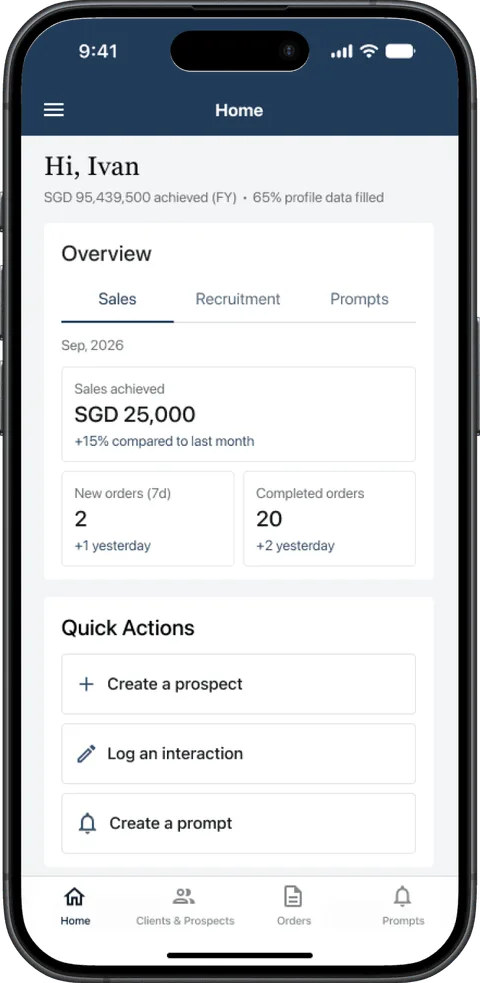
- Who should I act on today? To prioritise the right clients and prospects.
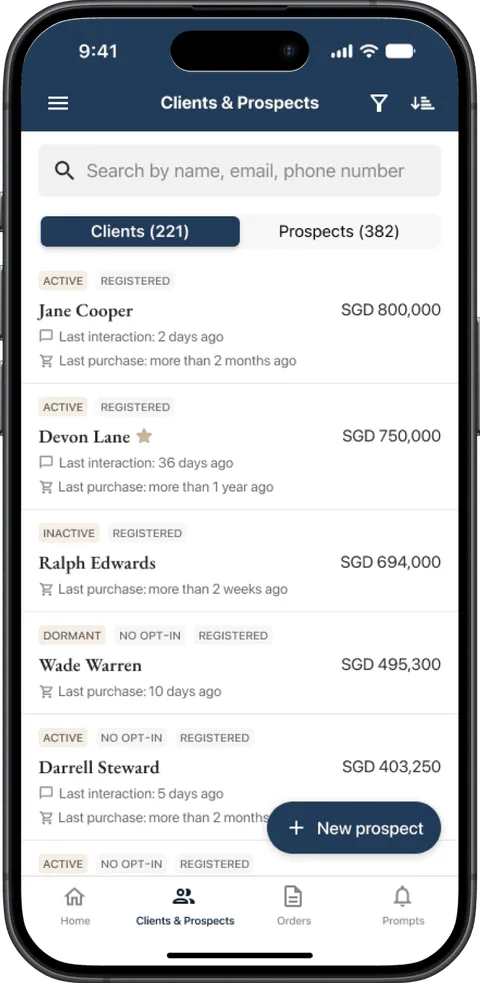
- What do I know about this client? To walk in prepared.
- What should I pitch next? To take informed clienteling actions.
Workshops with PCMs mapped which information each action needs
Brainstorming workshops with PCMs mapped which actions they take and the information each one needs. Client background (profession, hobbies and so on) and interaction history mattered most, which defined the feature scope for the three questions.
Solutions
Three use cases, each answering one question in the PCM's day.
Use case 1: Who should I act on today?
Use case 2: What do I know about this client?
Use case 3: What should I pitch next?
We left out an outreach-material library and reporting analytics (neither was ready to scope), and a prospect form I'd explored: PCMs focus on nurturing existing clients, so prospect capture wasn't the priority in most markets.
Complexity at scale
Rolled out in three waves, and the final wave was blocked until role-based access was designed.
The third wave was blocked until role-based access existedThe app rolled out in three waves. The final three markets sold through resellers, senior PCMs and sub-PCMs. Without role-based access, a junior assistant or an external reseller would see every client, which concerned the business and the data-privacy teams. I designed the role-based access that unlocked those markets, moving the PCM list dropdown into the menu.
Role-based access: options explored for the outsourced sales structureImpact
Not just rolled out to 12 markets, but actually used.
PCMs started to abandon Excel and use the app regularly: 76% of end-users use it every month, and they keep adding to it. From Jul 2025 to Jun 2026, they created 894 prompts and 625 interaction logs.
Rolled out to all 12 markets76%
of end-users active monthly
12
markets rolled out
894
prompts created (Jul 2025 – Jun 2026)
625
interaction logs created